Skip to content

Taxonomy term

Content type

Running, representation and resilience

Movement has always been more than exercise for me.

My first motivation was staying healthy and trying to stave off hereditary diseases like hypertension and diabetes that run in my family (and, so far, I'm happy to say it has worked!).

But movement quickly became my outlet, my reminder that I am alive, capable and able to set goals.

The power of movement

When I lace up my trainers and step outside, I am not only moving my body. I am moving through history, community and identity, and I am claiming me. I do this for me.

This year the theme for Black History Month is ‘Standing Firm in Power and Pride’, highlighting the resilience and contributions of the Black community, and I am reminded that movement has long been a form of resistance, survival and celebration for Black people.

From dance to sport, movement has always been our way of claiming space, telling stories and showing strength and, for me, running is my chosen form of movement. It gives me freedom, resilience, and connection – three qualities that shape how I live and lead.

Growing up, I saw elite athletes who looked like me on TV, but I did not see everyday women like me running.

Running was not something I thought belonged to me as an adult (child me, yes, because children always run), but the first time I tried it outside as an adult, something shifted – it was not about speed or medals, it was about finding a rhythm that was mine.

Over the years, running has carried me through joy and pain.

It has helped me navigate life’s challenges, from grief and motherhood to menopause and leadership, and it has also changed how I see myself, not as the fastest or the best, but as someone who shows up, puts one foot in front of the other and keeps going.
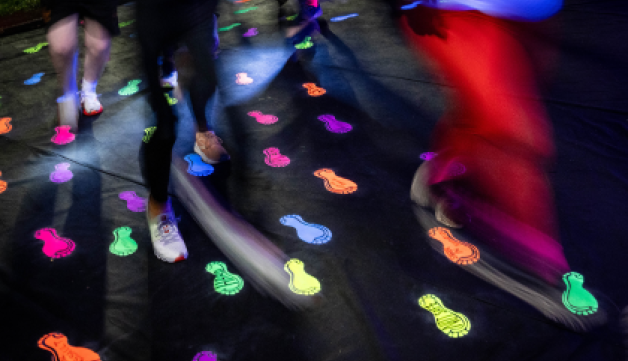
This year the theme for Black History Month is ‘Standing Firm in Power and Pride’, highlighting the resilience and contributions of the Black community, and I am reminded that movement has long been a form of resistance, survival and celebration for Black people.

Running has also shown me how much representation matters.

There have been times I felt invisible at races or out of place in running communities, but when I began sharing my story and weaving my Jamaican heritage into my running, I discovered others felt the same and that, by stepping forward, I could help them feel seen.

Showing the real deal

That is why I am proud to be part of the advisory board for This Girl Can.

For the Phase Six of the campaign, we have focused on showing women as they truly are: sweaty, busy, imperfect and joyful.

Not polished versions of women exercising effortlessly, but showing real women making time for movement in the midst of their busy lives.

Being on the advisory board has given me the chance to share my perspective, especially around the barriers that Black women face in sport.

From worries about hair care, to feeling unsafe in certain spaces, to simply not seeing ourselves represented, these are real issues that stop many of us from moving freely.

Phase Six is about breaking those barriers down and telling a wider story of who belongs in movement.

This new stage of the campaign is also about making sure that when women see the campaign, they see someone who looks like them, lives like them and feels like them. Because when you can see yourself, you start to believe you belong.

From local to national

In 2019, I founded Black Girls Do Run UK.

What began as a small idea, creating space for a handful of Black women to run together, has grown into a nationwide community, because we are more than a running group. We are a family!

We celebrate milestones, we share struggles and, more than anything, we create spaces where Black women can move without judgement or stereotype.

Alongside leading the community, I hold both the Leadership in Running Fitness and Coaching in Running Fitness qualifications.

These have allowed me to support runners of all abilities, from beginners to those chasing big milestones, and to bring structured, safe and inclusive coaching into our spaces.

For us, running is not about chasing times, and all about creating a memory bank, not metrics.

It is about laughing mid-race, stopping for photos and supporting each other at the back of the pack. It is about belonging.

Together in strength

Black Girls Do Run UK exists because representation matters.

Too often, Black women are absent from the imagery of running, but by showing up in our kit at races and online, we are rewriting that narrative. We are saying we are here, we run and we belong!

For me, movement is freedom. It is the freedom to be myself, to take up space and to live well in my body and during Black History Month, that freedom feels especially powerful.

We honour the struggles of those before us, celebrate the present and move with hope for those who will come after because movement connects past, present and future.

It reminds us that while the barriers are real, so is our resilience, and it proves that when women move, communities move and change becomes possible.

So this Black History Month, I celebrate movement in all its forms: the steps, the strides, the miles and the memories. Movement has shaped me, and I will keep moving, for myself, for my community, and for the generations yet to come.

Finding your place in the water

Around midnight on Saturday, 24 April 2021, 20-year-old Folajimi ‘Jimi’ Olubunmi-Adewole was walking home from work. He was crossing London Bridge with his best friend, Bernard Kosia, when they heard a woman crying for help.

The cries were coming from below. The woman had fallen into the River Thames.

Jimi was adamant about what should happen next. He told Bernard to stay on land because he didn’t know how to swim. As for Jimi, he decided to jump in to try and save her.

A black woman wearing a swimming cap looks ahead while in the water of an indoors swimming pool.

A post-mortem examination later found that Jimi had died as a result of drowning.

Jimi’s life was tragically lost. A life lost far too soon. A loss that makes our work at the Black Swimming Association (BSA) more vital than ever.

The BSA was born in 2020 to act as a bridge between the aquatic sector and disenfranchised and marginalised groups, including those of Black British heritage.

According to Sport England’s Active Lives Survey from that year, prior to the Covid-19 pandemic, 95% of Black adults and 80% of Black children did not participate in swimming activities regularly, compared to 89% of White British adults and 71% of White British children.

At the BSA, we work to ensure that African, Caribbean and Asian communities across the country have equitable access to vital water safety and drowning prevention education.

This includes understanding what to do in an emergency, as well as the potentially life-saving benefits of being able to swim.

Moreover, while the general public is largely aware of the benefits of engaging with aquatic activities (such as rowing, sailing and canoeing), the reality is that not everybody has access to them.

And that’s just the tip of the iceberg.

The BSA was born in 2020 to act as a bridge between the aquatic sector and disenfranchised and marginalised groups, including those of Black British heritage.

The BSA is the commissioning body of the pioneering research project #OurSwimStory, which investigated the attitudes towards, and the experiences of, water safety and aquatic activity among communities of African, Caribbean and Asian heritage in the UK.

This research was conducted in partnership with AKD Solutions (an organisational change consultancy) and provided a series of insightful and eye-opening findings, such as 48% of survey respondents weren’t aware of how to stay safe in water, 44% said they had a fear of water, and 33% of Black survey respondents indicated that hair was a barrier to engaging in aquatic activity, making hair the most commonly selected barrier within this group.

In addition, the cost of aquatic activity was highlighted as a barrier to engagement, and with the current cost of living crisis (and the associated reduction in disposable income) this barrier is expected to have an increasing impact on participation.

Moreover, some of the participants didn’t perceive swimming and aquatic activity as being for them, rather they associated aquatic activity with white and middle-class populations.

But, there is a positive.

Based on the barriers identified within the #OurSwimStory research, eleven recommendations were formulated, with the aim of increasing water safety awareness and aquatic participation.

These recommendations were reviewed by a panel of Equality, Diversity and Inclusion professionals, and include the following:

  • Use a replicable inclusivity framework to understand local communities.
  • Increase access to water-safety knowledge and skills sessions for ethnically diverse communities.
  • Recruit and train an ethnically diverse workforce.

We hope that the aquatic sector (including governing bodies, leisure operators and policy makers) will collaborate with the BSA in order to implement these recommendations and encourage more people to find their place in the water on their own terms.

Our goal is for everybody to be able to enjoy being in, on and around the water, and to do so in a way that’s safe and fun.

We aim to build trust within disenfranchised communities and improve access to the endless benefits and opportunities that the ever-changing aquatic sector has to offer.

We do this through providing life-saving education.

People tend to know that you should call 999 in an emergency. However, it’s less commonly known that if you see someone in trouble in the water you should ask for the coastguard if you’re by the sea or the fire brigade if you’re inland.

Bernard Kosia said that his best friend, Jimi, was a confident swimmer.

However, there is evidence that around half of those who die from accidental drowning are deemed to be swimmers, revealing that being able to swim is not sufficient to be safe in, on and around the water.

Moreover, 60% of accidental drownings happen inland - in places like rivers, reservoirs, lakes and quarries - and of those who drown, more than 80% are men.

In addition, recent evidence from the National Child Mortality Database reveals that the risk of drowning is higher among children and young people living in England’s most deprived neighbourhoods, as well as among children and young people of Black or Black British heritage.

As a young Black man from south-east London, we don’t know what kind of water safety education Jimi was exposed to, but what we do know is that education can save lives.

This work goes beyond Black History Month. It’s our every day.

We work for everybody to enjoy the water, to thrive and to reap the benefits.

We work to improve access to employment opportunities within the aquatic sector.

But mostly, we work so that tragic deaths, like Jimi’s, don’t happen again.

Anyone can drown. No one should.

Find out more

#OurSwimStory