Skip to content

Taxonomy term

Content type

The future of inclusive sport

From the bloodandthunder drama of para ice hockey (I challenge anyone to watch a match and not feel exhausted) to the debut of mixed doubles curling, the Milano Cortina 2026 Paralympics Winter Games delivered far more than sporting excellence.

We’ve witnessed what human potential looks like when barriers are removed and inclusion is real, but climate change is shifting and rebuilding those barriers – making them higher, harder and, for some, insurmountable.

This is because climate change exacerbates inequality, threatening the hard-won gains made by disability activists over decades and, while progress has been huge, the extreme change in our weather and its effects on Earth are a stark reminder of how fragile that advancement is.

We even saw the impact of climate change at the Games, with some athletes voicing concerns that the March schedule for the event is now too late in the year and that competition conditions were being impacted by warm 'spring-like' weather.

The lesser known dangers of climate change 

Evidence submitted to Parliament is unequivocal: disabled people are more negatively affected by the health and social impacts of climate change than the general population – not primarily because of their impairments – but because systems already fail to meet their basic needs.

People living with disabilities – who are already twice as likely to be inactive according to our research, but who gain the most for their wellbeing from being able to take part in sport and physical activity – are disproportionately affected by rising heat, greater flooding risk and disruptions to accessible transport.

Sport England’s mission is to enable more people take part in sport and activity, but extreme weather is already making that harder.

From washed-out pitches to heatwaves that make outdoor sport unsafe, extreme weather has already prevented three in five adults in England from being active.

Climate research consistently shows why this happens and it’s simple and disheartening – disabled people are routinely excluded from climate adaptation planning.

Globally, 80% of national climate strategies fail to reference disability, leaving huge gaps in preparedness and emergency support.

And wherever disabled people are mentioned at all, they are often labelled as ‘inherently vulnerable’ – a misconception that shifts responsibility away from systems that fail to include them.
 

We’ve witnessed what human potential looks like when barriers are removed and inclusion is real, but climate change is shifting and rebuilding those barriers – making them higher, harder and, for some, insurmountable.

When torrential and constant rain hits it’s harder to manoeuvre a wheelchair outside. When a ramp floods, when accessible transport is disrupted, when a facility closes ‘for a few days’, some people lose far more than a chance to exercise. They lose independence, community and joy.

If we want to protect the magic of sport and movement – plus the hard-won progress of inclusion in sport for people with disabilities – we must protect the planet that makes sport possible.

That is why Sport England’s mission to help people get active now include helping the planet stay stable.

In May 2024, we launched Every Move, our first environmental sustainability strategy, to help the 150,000 sports clubs and 98,000 facilities across England sitting on the frontline of climate impacts.

We backed this with more than £45 million of National Lottery funding and already more than 570 interventions are underway, including solar panels on roofs, energy efficient systems in leisure centres or redesigned outdoor spaces to cope with flooding.

These changes cut carbon and also keep facilities open, safe and accessible for the communities who depend on them most.

On top of these, all of our partners must have sustainability action plans in place by March 2027 as a funding condition.

This isn’t a box-ticking exercise, but about futureproofing the places and spaces that people rely on to stay active, healthy and connected as communities, including our swimming pools, village halls, football pitches or athletics tracks, to name a few.

Community action agains climate change 

It’s great to see how sport is willing to innovate to face the disrupting weather conditions.

Football and all-weather pitches are working with us to explore transitions away from rubber infill and to increase recycling capacity, with the ambition to be the first in the world to have a fully sustainable system by 2035.

Elsewhere, leisure centres are switching to more efficient systems and community clubs are testing and implementing changes.

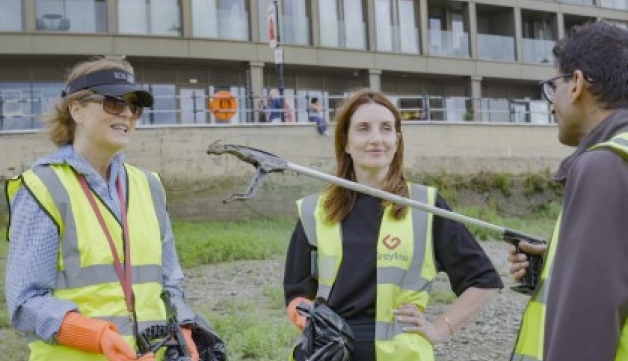
Be it the guys at Whalley Range Cricket & Lawn Tennis Club, who are planting trees on the outskirts of playing fields to better soak up excess water, or the river clean-ups hosted by Fulham Reach Boat Club – an organisation doing great work through Row to Rhythm, a project for individuals with visual impairments.

Actions like these collectively truly add up to major impact.

Going back to international competitions, the challenges facing the Winter Paralympics, and winter sport more widely, should not drive despair. They should galvanise us instead, because sport has always been about rising to the moment and responding to the now.

And right now, the moment demands that we confront climate change not just as an environmental issue, but as a justice matter – one that threatens to undo decades of progress in making sport accessible, inclusive and transformative.

If we want a future where Paralympians can still inspire the world from real snow and real ice, and where disabled people everywhere can access the benefits of movement, we must act together and we must do so right now.
 

Garon Park

Two people hold aloft onions in a community allotment. Learn more about Garon Park, a thriving community hub in Southend-on-Sea that tackles health inequalities while boosting biodiversity. Sustainability

The Green Runners

The Green Runners logo Learn more about The Green Runners, a community of environmentally conscious runners who have developed a clear approach to reducing carbon emissions within the running community. Sustainability

Active Devon

Active Devon logo, featuring an abstract icon of a person moving. Find out about Active Devon's simple approach to carbon footprinting, which has led the Active Partnership to become advocates for environmental stewardship and low-carbon lifestyles. Sustainability
Communities on the edge

Coastal communities are some of the most beautiful places in England and many of the country’s wealthiest spots are on the coast.

But it is also true in England that a disproportionate number of the places suffering the most deprivation, worst physical and mental health outcomes and lowest healthy life expectancy are on the coast too.

All this may read contradictory, but coastal communities haven’t ended up in this position by accident.

Many were once thriving seaside economies, built on tourism and seasonal work, but as those patterns changed, they left behind communities with deep roots but with fewer opportunities than those in urban and rural communities.

This deteriorating state of coastal living standards is driven by deprivation and the complex and challenging issues around housing, transport and employment, which together lead to disproportionate lower levels of physical activity.

As Sport England highlight with their sustainability strategy, Every Move, adding to these challenges is that those facing the greatest inequalities are often the least active and the most affected by climate change.

Plus, coastal communities are facing significant climate effects through coastal erosion, flooding and the fact that industries on the coast are the ones producing the majority of the UK’s carbon emissions.

So how can we turn the tide on physical inactivity on the coast?

Can you define ‘coast’?

It is amazing that whilst we are an island, there is no agreed government definition for the term ‘coast’, unlike clear definitions for urban and rural areas.

This leads to the coast often being lost in talks around deprivation as the debate revolves around those in urban and rural areas.

The deteriorating state of coastal living standards is driven by deprivation and the complex and challenging issues around housing, transport and employment, which together lead to disproportionate lower levels of physical activity.

The Coastal Navigators Network, which tackles health inequalities on the coast, has identified that whilst coastal communities are often small individual places, when considered together, they are as large and significant as a national population group (19%) and the near equivalent of the entire North West and North East regions combined.

So with this in mind, what inequalities do people living in coastal areas face in terms of access to sport and physical activity?

The most obvious one is that for coastal communities half their catchment area is in the sea!

Away games are often long car journeys to the far away urban areas for at least half of their season and let's not forget about those extra carbon emissions!

However, it is the opposite for their urban colleagues, who consider their fixture in the season on the coast as going to the seaside for the day!

Sport and physical activity has come late to the policy work across England about improving opportunities for coastal communities, but is now beginning to build the partnerships with organisations like the Coastal Communities Alliance, OneCoast, the Coastal Navigators Network, and the Coastal Cultural Network.

In fact, in February 2026, the APPG Coastal Communities have scheduled a briefing session on the Culture, Creative & Sport Sector in coastal communities. (Please note that while no final information is available yet, the Coastal Community Alliance is currently organising this with the APPG, so check their sites and socials for more information.)

Where is the good work happening?

Five years on from its launch, Active Withernsea is making a real difference in creating physical activity opportunities and lifestyles and transforming its local community.

Local data by Sport England-funded Active Withernsea highlights that while in 2018, 44% of people in Withernsea were inactive (that is doing under 30 minutes of exercise a week), this number has gone down to 15 % of residents being inactive in 2024.

Further, the percentage of residents who are now active increased from 44% to 62% over this time period.

Happiness and satisfaction with life have also improved and anxiety amongst Withernsea residents has decreased, while activity for those with a disability has seen the biggest increase.

A Physical Activity and Community Engagement (PACE) network has been established to lead physical activity projects going forward and ensure that the work continues with more than 100 residents, groups and partners now directing the next steps to continue to deliver physical activity for the people of Withernsea.

What Active Withernsea has shown is that when national policy makers do focus on coastal communities, significant change can help increase physical activity levels. 

What is also clear is that Sport England place-based funding has begun to turn the tide for coastal communities and that, together, we will keep working to improve the lives of those living by the sea.

Find out more

Active Humber

You've viewed of items.